Best Career Options After Learning Digital Marketing, AI, or Data Science
,
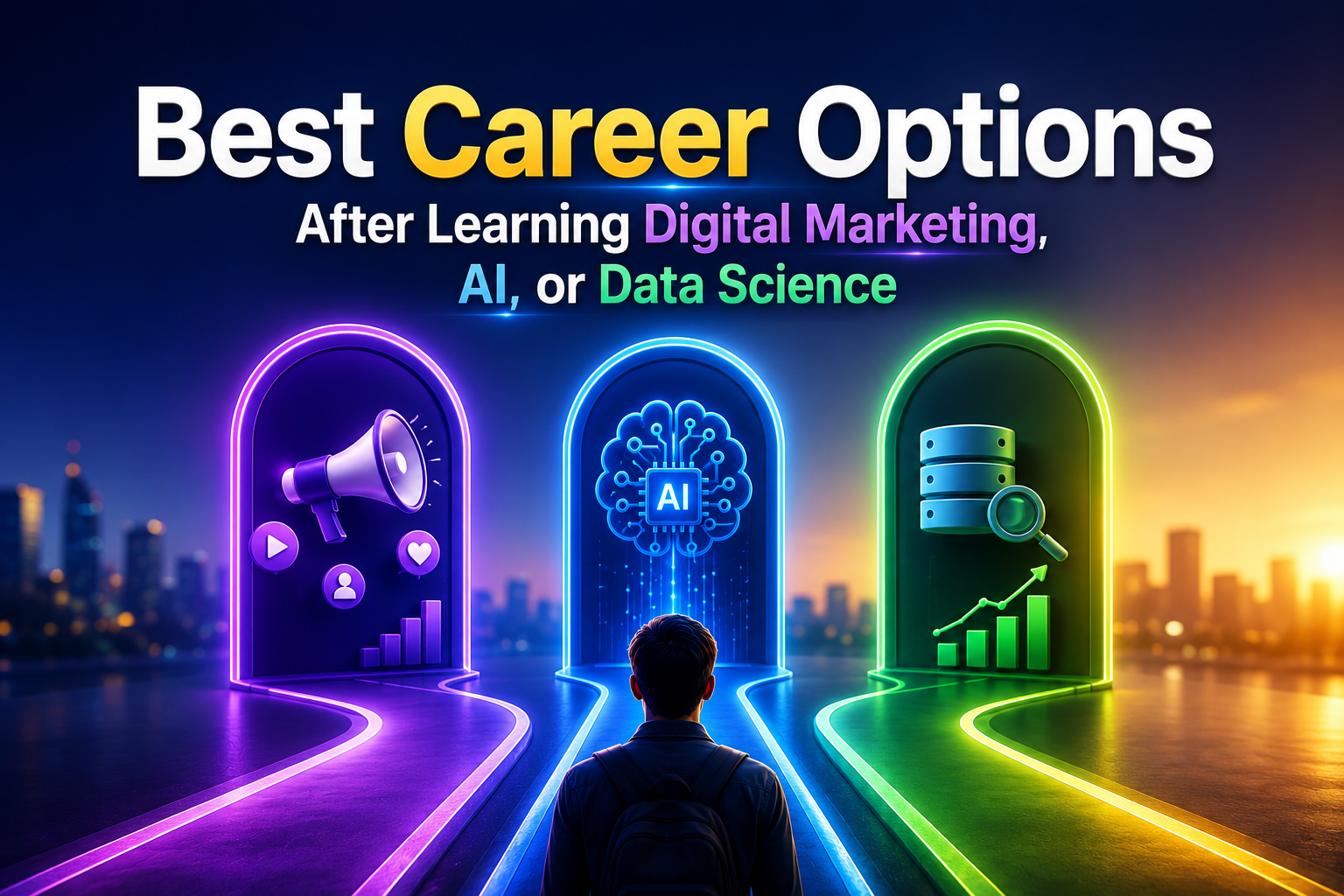
,
People often ask me this: I have learned the skills. What next? This happens every week and it comes from students who are just starting out or people who are changing their jobs. It is a question to ask. Learning the skills is one thing, knowing what to do with the skills is something. I have learned the skills. What next is a question that many people have and it is not easy to find the answer to what to do, with the skills you have learned.
I have been working in this field for a time. Over ten years. I have taught students. See what happens when they look for jobs. I have also seen which jobs are really good and which ones just sound good. Now I want to tell you the truth about what happens after you take a Career After AI Course or a Digital Marketing course or a Data Science program. I will not make any promises that are not true. I will just show you what these courses are really like today. I will give you a picture of what a Career After AI Course is like and what a Digital Marketing course is like and what a Data Science program is, like.
The job market has changed fast in the last three years. It changed more in three years than it did in the ten years before that. Now we have jobs that did not exist a year ago. For example companies are hiring people to work as AI specialists or marketing automation experts. The job market is. Some old jobs are disappearing. Some traditional jobs have faded away. Have become part of bigger jobs that use a lot of technology. The job market is really different now because of the changes in the past three years. The job market has. New jobs, like AI prompt specialists and marketing automation experts are being hired for.
The old idea that you can just get a certificate and then you will find a job is not true anymore. Now what is important is knowing where the actual opportunities are and putting yourself in the place, in the opportunities. You have to understand the opportunities and position yourself correctly in the opportunities to be successful.
Let's break this down by field.
Digital marketing remains one of the most flexible and accessible fields to build a career in, mainly because almost every business — big or small — needs some form of online presence. A solid Digital Marketing Career can branch out into several directions:
Helping businesses rank higher organically on search engines. This role has aged well because organic visibility never really goes out of demand.
Running and optimizing Google Ads, Meta Ads, and other paid campaigns. Businesses will always need people who can turn ad spend into measurable ROI.
Beyond just posting content, this role now involves strategy, analytics, and increasingly, AI-assisted content planning.
Businesses are producing more content than ever, and skilled writers who understand SEO and audience psychology are consistently in demand.
This is where digital marketing starts overlapping with data — analyzing campaign performance, customer behavior, and ROI using tools like Google Analytics and Looker Studio.
A lot of my former students eventually move into freelancing or start their own small agencies once they've built enough hands-on experience. This path takes longer but offers the most independence long-term.
This is the field generating the most buzz right now, and honestly, a lot of that buzz is justified. But it's important to be specific about what "AI jobs" actually look like for someone starting out, versus the misconception that everyone becomes a "machine learning engineer" overnight.
Realistic AI Jobs for beginners and intermediate learners include:
Businesses across marketing, e-commerce, and content industries need people who can effectively use AI tools to create content, automate workflows, and improve efficiency. This role has grown rapidly and doesn't require a deep coding background.
Helping businesses adopt and integrate AI tools into their existing workflows — from customer support chatbots to marketing automation. This is a practical, in-demand skill set right now.
Combining basic data analysis skills with AI tools to speed up reporting, forecasting, and insight generation. A great entry point for those who like data but aren't ready for a full data science role yet.
Businesses want to automate repetitive tasks using AI — and someone who understands both business processes and AI tools can carve out a valuable niche here.
For those who want to go deeper technically, roles like AI/ML Engineer or NLP Engineer are absolutely available too, but they typically require additional programming and mathematical foundation beyond a foundational AI course. It's worth being honest about that distinction from day one.
Data Science continues to be one of the more technically demanding but highly rewarding fields. Data Science Jobs typically fall into a few common entry points:
Often the first step into this field — analyzing datasets, building reports, and identifying trends using tools like Excel, SQL, and Power BI or Tableau.
Focused on turning data into business strategy — a role that blends data skills with business understanding, and is in strong demand across industries.
Working with predictive models, data cleaning, and basic machine learning under guidance, usually after building a strong foundation in analytics first.
Turning complex data into clear, understandable dashboards and reports — a highly valued and often underestimated skill.
One thing I want to be honest about is that a lot of people who are just starting out really want to be called a Data Scientist.. The truth is, most people start out in jobs like data analyst. This is not a thing. It is actually a way to start a career in this field that will last. Data Scientist is a job title but people usually start as data analysts first. This is how most people build a career in the field of data science.
Regardless of which path you choose, a few things consistently separate people who grow quickly from those who plateau:
Employers want proof, not just theory
Knowing what SEO is matters less than knowing how to actually run an audit
These fields evolve fast; stagnant skills age quickly
Especially important in digital marketing and data roles
A surprising number of opportunities come through LinkedIn visibility and referrals, not just job portals
Honestly, this depends less on "which field is best" and more on what naturally interests you. I've seen students thrive equally in all three areas — the common factor was always genuine interest paired with consistent practice.
It's also increasingly common — and honestly, increasingly valuable — to build a hybrid skill set. A digital marketer who understands AI tools, or a data analyst with marketing awareness, tends to stand out far more than someone with narrow expertise in just one lane.
There is no one career path that's best after you learn Digital Marketing, AI or Data Science. What works for you is the path that you like and you get to learn by actually doing things. The important thing is to pick a field you want to work in, keep learning by doing hands-on work and show people what you can do rather than just having a certificate.
If you are trying to figure out what to do do not worry too much about getting a job that is popular right now. Instead, think about what you're really interested in. A good Career After AI Course or a good understanding of Digital Marketing or Data Science can help you. It is the work you put in every day that really matters. Digital Marketing, AI or Data Science can take you far if you keep working at them.


We are a leading AI Powered Digital Marketing & Data Science Institute in Uttam Nagar, Delhi. We provide 100% practical training in SEO, Google Ads, Social Media Marketing, Artificial Intelligence, and Automation tools to help students build high-income careers, freelancing skills, and business growth.