How AI Is Transforming Careers and Why You Need to Learn It
.
.
The job market of 2026 looks nothing like it did five years ago. Roles are being redesigned. Entire departments are being restructured around automation. The professionals who are thriving all share one thing in common. They invested early in learning intelligence. If you've been wondering whether it's finally time to enroll in an Artificial Intelligence Course this is the sign you've been waiting for. AI is no longer a "nice to have" skill. Its fast becoming a requirement across nearly every industry.
In this blog we'll break down how AI is reshaping careers. We'll explore why an AI Course is one of the investments you can make in 2026. We'll also discuss how the right AI Certification Course can open doors to some of the in-demand jobs in the world today.
AI has moved beyond chatbots and recommendation engines. Today its embedded in hiring processes, marketing strategy, financial forecasting, healthcare diagnostics, software development, customer service and supply chain management. Companies are no longer asking "should we adopt AI?" They're asking "how fast can we scale it?"
This shift has created an effect across the job market:
Routine and repetitive tasks are being automated. This frees up workers for higher-value strategic work.
New job roles are emerging. AI trainers, engineers, machine learning operations specialists and AI ethics officers didn't exist a decade ago.
Existing roles are evolving. Marketers now need to understand AI-driven analytics. HR professionals use AI for talent screening. Even lawyers use AI tools for contract review.
Decision-making is becoming data-. Ai-driven. Professionals who understand how these systems work have an edge over those who don't.
The bottom line is that AI is already touching your industry. Its only accelerating. This is why enrolling in a structured Artificial Intelligence Course has become one of the most future-proof career decisions a professional can make.
Lets talk numbers for a moment. Every major job market report over the two years has pointed to the same trend. AI-related roles are growing faster than any other category. The demand consistently outpaces the supply of talent. This talent gap is why an AI Career is such an attractive path right now. There is competition, higher pay and long-term job security.
Here's what makes an AI-focused career path so compelling:
Professionals with AI skills consistently command higher salaries than their peers without them. Even a foundational understanding of machine learning, natural language processing or generative AI tools can significantly boost your market value.
AI expertise is portable. A marketer who understands AI-powered personalization a supply chain analyst who can build models or a customer support lead who knows how to deploy AI chat assistants. All of them become significantly more valuable to employers.
Automation is often framed as a threat to jobs. The reality is more nuanced. AI doesn't just replace jobs. It replaces tasks. The professionals at risk are those who refuse to adapt. Those who upskill through an AI Course position themselves as the people who manage, guide and optimize AI systems than being replaced by them.
designations like AI product manager, machine learning engineer AI solutions architect and conversational AI designer are opening up rapidly. Many of these roles didn't exist before 2020. Most require some form of training or certification to break in.
One of the exciting aspects of this transformation is how widely AI Jobs are spreading across sectors that were traditionally considered "non-technical." Here's a quick look at where demand's surging:
Healthcare – assisted diagnostics, medical imaging analysis and personalized treatment planning
Finance – Fraud detection, algorithmic trading, credit risk modeling
Retail & E-commerce – Demand forecasting, personalized recommendations, inventory optimization
Marketing – Content generation, customer segmentation, campaign automation
Manufacturing – maintenance, quality control automation, robotics integration
Education – Adaptive learning platforms, automated grading, personalized tutoring systems
So Artificial Intelligence does not mean you have to become a programmer to have a career in Artificial Intelligence. Now there are jobs for people, like strategists and analysts and project managers and creatives who know how to use Artificial Intelligence tools in their field.
This is the gap that a good Artificial Intelligence course is made to fill. It teaches you about the side of Artificial Intelligence and how to actually use it in a job and it does not matter what your background is.
With many free tutorials and YouTube videos available you might wonder why a structured AI Certification Course matters. The answer comes down to three things: credibility, structure and speed.
A recognized certification signals to employers that you've been trained on real-world tools, frameworks and case studies. Not just theory. In a hiring landscape a certificate from a reputable Artificial Intelligence Course can be the differentiator between two equally experienced candidates.
Self-learning is valuable. However it's easy to get lost in an ocean of scattered resources. A designed AI Certification Course provides a clear curriculum. Covering machine learning fundamentals, data handling, generative AI, natural language processing and practical projects. So you build skills in a logical cumulative order rather than piecing things together randomly.
Certification programs are typically designed with career outcomes in mind. Many include portfolio-building projects, interview preparation and placement assistance, which significantly shortens the time between "I want an AI career" and "I landed an AI job."
Not all training programs are created equal. Before you commit your time and money evaluate a course on these factors:
Does it cover both concepts (statistics, Python, machine learning) and applied skills (generative AI, prompt engineering, AI tools)?
Theory alone won't get you hired. Look for programs with real-world case studies and portfolio projects.
Choose an AI Certification Course that's respected by employers in your target industry.
Access to instructors or industry mentors can dramatically improve your learning outcomes.
Resume building, interview prep and job placement assistance add value beyond the classroom.
Here is the truth. While you are deciding whether Artificial Intelligence skills are worth it someone else in your industry is already three months into their Artificial Intelligence Course, building projects and applying for roles you might want this year. The skills gap in Artificial Intelligence is not closing. It is widening. People who start using Artificial Intelligence early are getting rewards like promotions, salary increases and career changes.
This does not mean you need to become a researcher who specializes in machine learning. It means you should learn enough, about Artificial Intelligence to use Artificial Intelligence tools with confidence understand what they can and cannot do and use them in a way that makes sense for your job. A good Artificial Intelligence Course will teach you the skills you need to do these things with Artificial Intelligence.
Artificial Intelligence is here to stay. It is changing how we work. This change is happening across all industries. The professionals who will do well in the decade are not just the smart ones or those with lots of experience.
They are the ones who started using AI , If you are just starting your career and want to work with AI or if you want to make sure your current job is safe, in the future then joining an Artificial Intelligence Course is a very smart decision. You should also get a certificate in AI from a known place.
Certification Course and you're not just learning a skill. You're investing in long-term career resilience.
The AI wave isn't coming. It's already here. The only question left is whether you'll be riding it or watching it pass you by.


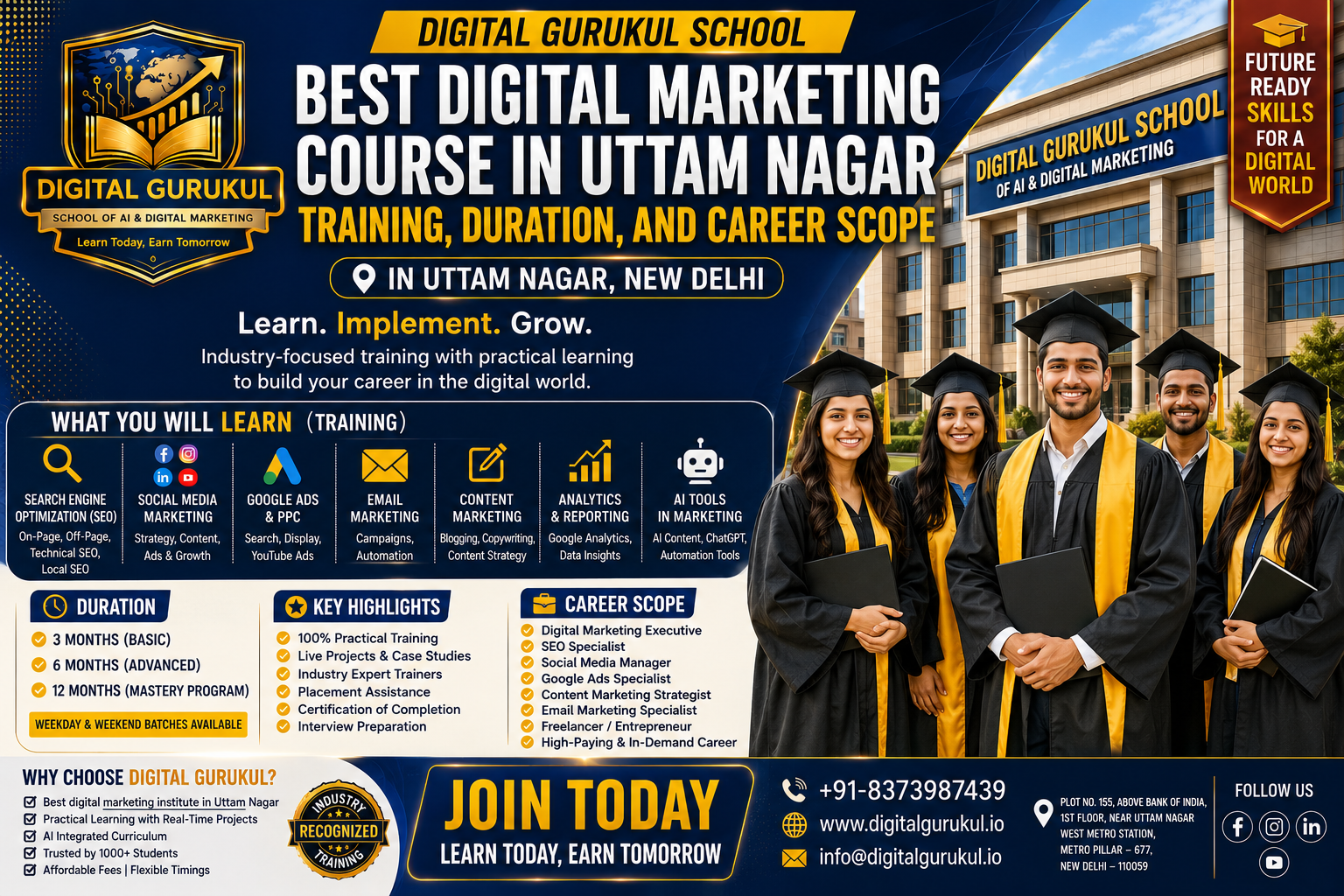
We are a leading AI Powered Digital Marketing & Data Science Institute in Uttam Nagar, Delhi. We provide 100% practical training in SEO, Google Ads, Social Media Marketing, Artificial Intelligence, and Automation tools to help students build high-income careers, freelancing skills, and business growth.