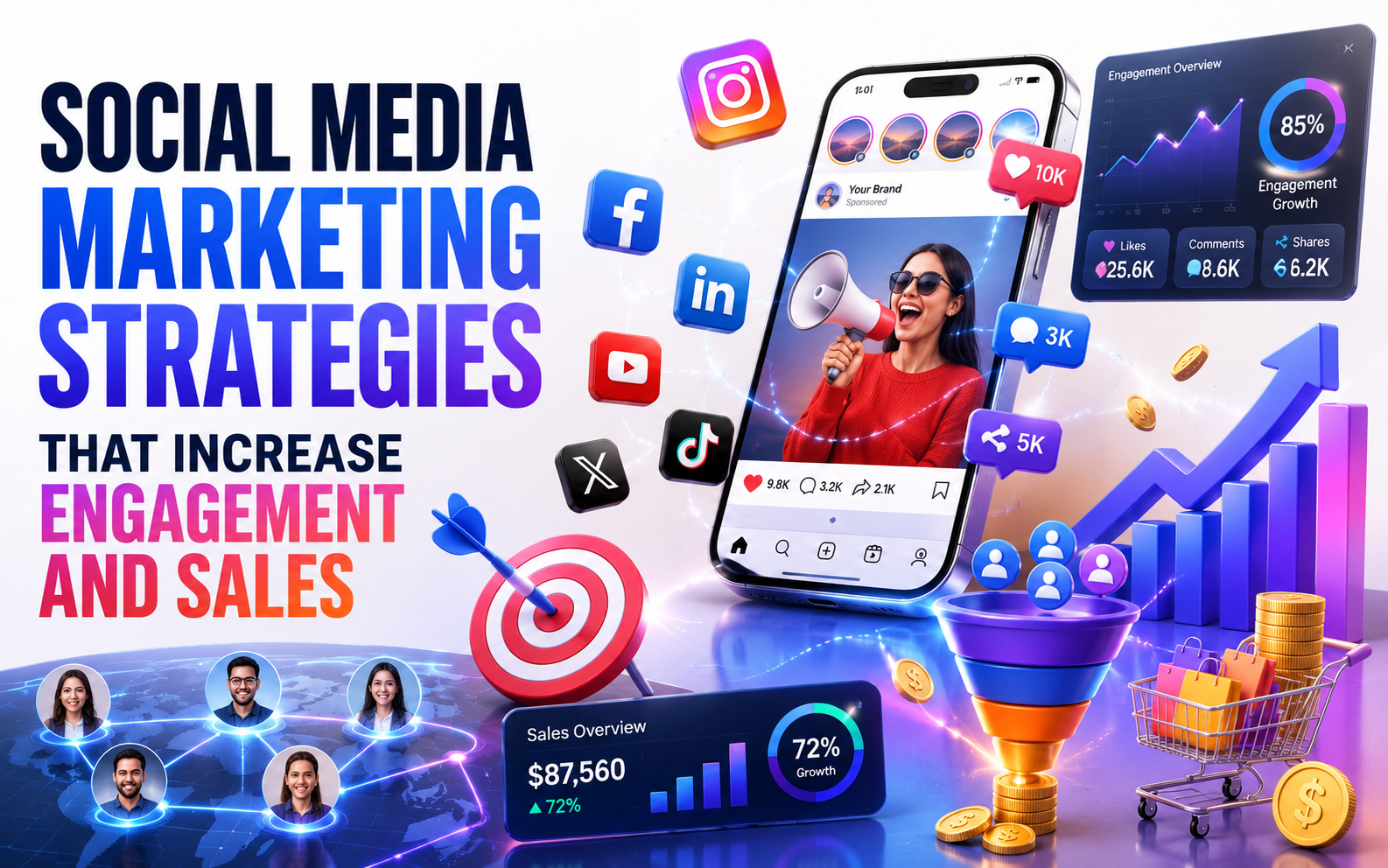
Social Media Marketing Strategies That Increase Engagement and Sales
.

.
I have met a lot of businesses that have a media page.. Most of them do not have a real Social Media Marketing plan. There is a difference between putting up posts all the time and putting up posts that people actually care about and that help sell things.
I have been taking care of social media accounts for clients and teaching students about this for a time. I have seen the same thing happen over and over. Businesses that use media in a smart way do well and grow slowly. Businesses that just use social media because they think they should not do very well. Let's look at what works.
Social media marketing is when you use Instagram, Facebook and LinkedIn to get people to know your brand, talk to the people who like your brand and get results like new customers, sales or people who come back to buy from you again.
Social media marketing matters because people do not just use media when they are bored they use it to find out about brands before they decide to buy something. If your brand does not look good on media it can hurt your business even if your product or service is really good. At its core social media marketing is about using these platforms to build trust with people, which means you need to have a plan for each one and it is just as important as being on social media, in the first place.
Different platforms serve different purposes, and treating them all the same is one of the most common mistakes businesses make. Here's how to approach each one strategically.
Instagram Marketing thrives on visual storytelling and consistency. A few strategies that genuinely move the needle here:
Reels over static posts
Short-form video content is getting more reach than static images right now simply because the platform actively promotes it.
Strong hooks in the 2 seconds
Attention spans are short; if a Reel doesn't grab interest immediately viewers scroll past before the message even lands.
Consistent visual branding
Using the color palette, fonts and tone across posts builds instant recognizability over time.
Interactive Stories
Polls, question stickers and quizzes in Stories increase engagement. Give direct insight into what the audience actually wants.
Clear CTAs, in captions
Don't assume people will know what to do, tell them clearly ("DM us to book " "Link in bio").
Facebook marketing works a little differently, since its audience tends to skew slightly older and the platform rewards community-driven content.
Facebook Groups
Creating or taking part in a group that focuses on an interest often builds more trust than just posting on a page by itself.
Longer-form content
Facebook users tend to respond to longer captions and more detailed posts compared to Instagram, especially when the content is informative or tells a story.
Event promotion
Facebook events are still not used much. They work really well for promoting webinars, workshops, or local business events.
Retargeting engaged users
Facebook Ads let you target people who have already interacted with your page or posts and this usually leads to results than trying to reach people who haven't seen your content before.
LinkedIn Marketing is often overlooked by businesses that aren't strictly B2B, but it's becoming increasingly valuable even for education and service-based businesses.
Thought leadership content
Sharing thoughts, real stories or real experiences helps people trust you more than just talking about your products or services.
Employee advocacy
Getting your team to share and talk about the company's content can help your message reach people on its own.
Personal branding
When a person like a founder or a teacher shares something on their page it often gets more attention and more trust than when the company itself posts.
Consistent value-first posting
People on LinkedIn like to learn something. Content that gives value and doesn't feel like a sales message works best.
Beyond platform-specific tactics, a few foundational strategies consistently drive both engagement and sales, regardless of which platform you're using:
1. You Need To Know Your Audience Before You Create Any Content
A lot of businesses make the mistake of creating content based on what they want to talk about, not what their audience actually wants to see. You should understand what your audience is struggling with, what questions they have and what they are interested in and use that to plan your content. Not the way around.
2. Make Sure You Are Giving Your Audience Value Of Just Trying To Promote Yourself
The accounts that keep growing are rarely the ones that just post "buy now" all the time. I always tell people that for every post that tries to sell something you should have at least three or four posts that teach people something that makes them laugh or give them something they can really use.
3. You Should Have A Plan For Your Content
Just posting things at random does not work well. If you plan your content ahead of time even if it is a simple plan for the week you can make sure you have a good mix of different types of content and that you are posting regularly. This is something that the social media platforms like to see. They will reward you with more people seeing your posts.
4. You Need To Talk To Your Audience Not Post Things
This is something that a lot of people forget to do when they are using social media to market themselves. If someone comments on one of your posts you should respond to them. If someone sends you a message you should reply to it. You should also be looking at what your audience's posting and talking to them about that. This is how you build relationships with people and the social media platforms can tell when you are doing this.
5. You Should Be Looking At The Numbers To Figure Out What Is Working
Every social media platform gives you numbers about how your posts are doing. How many people are seeing them, how many people are interacting with them and things like that. You should be looking at these numbers all the time to see what is actually working or just guessing what you think might work.
6. You Should Be Using Content That Your Audience Creates
If you can get your customers to share their stories, reviews or posts about your brand that is a great way to build trust with people. When your audience creates content it is like they are vouching for you and that can be really powerful. Your audience creating content is a deal and you should be using it to your advantage.
Engagement alone doesn't pay the bills — it needs to translate into actual business results. A few practical ways this connection actually happens:
Building familiarity before a sale
Most customers don't buy on the interaction; it takes time and effort to build trust. Providing valuable content helps people feel more comfortable and ready to make a purchase.
Retargeting engaged audiences with ads
People who have already shown interest in your content are more likely to buy. Using ads to reach them can lead to better results compared to trying to reach people who have never heard of you before.
Using proof strategically
Including testimonials, reviews and behind-the-scenes content can help people feel more confident about making a decision. It shows others have had experiences and can make the choice easier.
Clear, CTAs
Even the best content won't lead to sales unless it has a clear next step. A strong call to action tells people what to do next and helps turn engagement into real action.
Posting the same content across all platforms
Each platform has different audience behavior; a one-size-fits-all approach usually underperforms everywhere
Focusing only on follower count
A smaller, genuinely engaged audience almost always outperforms a large but passive one
Inconsistent posting
Sporadic activity makes it harder for algorithms to consistently show your content to your audience
Ignoring comments and messages
Poor response times can quietly damage trust, even when content quality is strong
I always tell students that social media marketing does not work well on its own. The businesses that do really with social media marketing are the ones that connect their social media strategy to their overall Digital Marketing plan. This plan includes things like search engine optimization, which helps people find their website when they search for something through email marketing, which helps turn people who visit their social media pages into customers and paid advertising, which helps spread the word about their content.
A good Instagram page can bring people to your website. If your website is not easy to use or if you do not have a way to turn visitors into customers then a lot of your effort is wasted. That is why we teach media marketing as part of a bigger plan that includes search engine optimization, paid advertising and content strategy. We want our students to understand how all of these things work together to help businesses succeed.
I have seen a difference between marketers who only know how to manage a social media page and those who understand the whole digital marketing system. The marketers who understand the system do a much better job and get better results for themselves and for the businesses they work with. If you want to learn about media marketing you should learn about it as part of the bigger digital marketing picture, not just as a single skill. This way you will be able to use social media marketing to help businesses succeed.
1. Which platform is best for a small business just starting out?
It depends on the audience. Instagram works well for driven or younger audiences and Facebook suits local and community-based businesses. LinkedIn is the fit for B2B or education-based brands.
2. How often should a business post in the media?
There's no number but consistency matters more than frequency. A realistic schedule you can stick to will always outperform posting one week and going silent the next.
3. Do paid ads work better than social media content?
They serve purposes. Organic content builds trust and community over time. Paid ads help you reach people quickly and prompt faster action. The strongest results usually come from using both
4. How long does it take to see results from social media marketing?
Meaningful engagement growth often takes months of consistent effort. Results can vary depending on your niche, content quality and how consistently you post.
5. Is Digital Marketing knowledge necessary to run media well?
Yes. Understanding fundamentals. Audience targeting, analytics and content strategy. Makes a real difference, in turning social media effort into actual business results.
Social media marketing is not about putting up a lot of posts. It is about making sure you have a reason for what you're doing. You need to know how people act on each website like Instagram, Facebook and LinkedIn and always give them something before you ask for something back.
Instagram, Facebook and LinkedIn are all different. They all do different things for a company. The companies that do well are the ones that use each social media website in a way that makes sense for that website. They do not just use the plan, for every website. If you get this right social media marketing will not just be something you have to keep up with it will actually help your business grow.

We are a leading AI Powered Digital Marketing & Data Science Institute in Uttam Nagar, Delhi. We provide 100% practical training in SEO, Google Ads, Social Media Marketing, Artificial Intelligence, and Automation tools to help students build high-income careers, freelancing skills, and business growth.