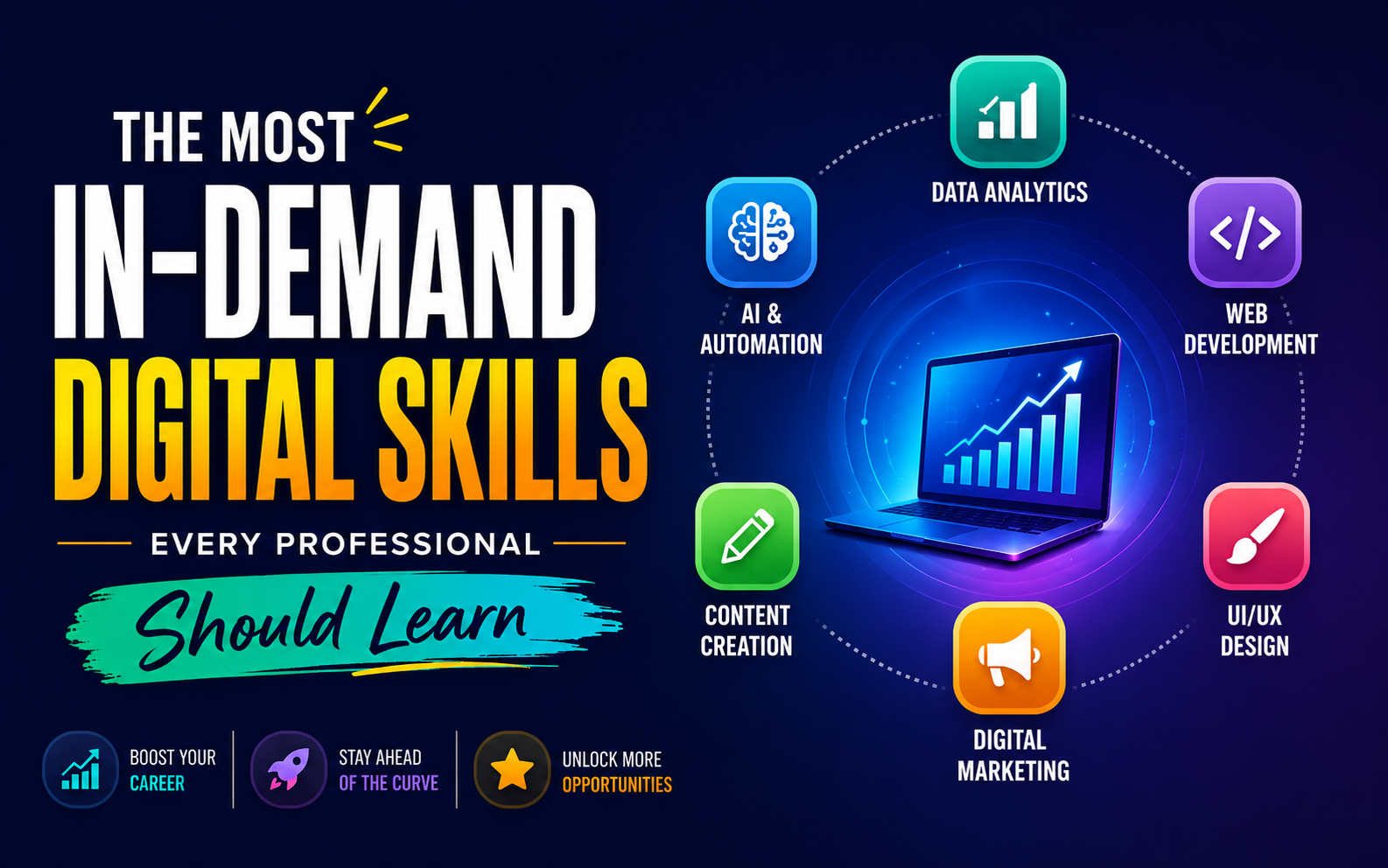
The Most In-Demand Digital Skills Every Professional Should Learn
.
.
Discover the most in-demand digital skills professionals need in 2026 — from digital marketing and AI skills to data science skills that boost career growth.
The workplace has changed fast in the last five years. It changed more in the five years than it did in the twenty years before that. Now we have automation and artificial intelligence and businesses that work remotely. This means that people who learn skills now are the ones who will be important tomorrow.
If you are a graduate or a manager in the middle of your career or you own a business, you need to learn digital skills. Learning skills is not something you can choose to do anymore. It is something you have to do if you want to have a career for a long time. Digital skills are the foundation of having a career that will last.
In this guide we will look at the important digital skills that every professional needs to know now. These skills are grouped into four areas:
By the end of this guide you will have a clear plan for which skills to focus on based on your career goals and what you want to achieve. You will learn about marketing and how it can help you. You will also learn about AI skills and their importance. Additionally, you will learn about data science skills and core marketing skills.
Modern industries like healthcare, manufacturing, and finance increasingly depend on digital infrastructure, making digital literacy essential. Developing key skills such as data analysis, cloud computing, and cybersecurity allows professionals to stay competitive in an automating job market, qualify for higher-paying roles, improve productivity, and transition smoothly between industries while building a standout personal brand.
With that context, let's look at the specific skill categories worth your time and effort.
Digital marketing remains one of the fastest-growing and most accessible digital skill sets to learn, largely because businesses of every size need an online presence to survive. Whether you want to freelance, join an agency, or grow your own brand, these are the core competencies to focus on:
Figuring out how search engines rank content is really useful. If you learn about keyword research and on-page optimization and technical search engine optimization and link building then businesses can get found by people when they search for things online without having to pay every time someone clicks on their link.
Social media platforms like Instagram, LinkedIn, and TikTok have become vital channels for sales and branding. Consequently, professionals who are skilled in content creation, algorithm navigation, and community building are highly sought after across all industries to drive business growth on these platforms.
The selected content highlights that running paid advertising campaigns on platforms like Google Ads, Meta Ads, and LinkedIn Ads requires a blend of creativity and analytical skills. Consequently, businesses seek skilled marketers who can efficiently manage their ad budgets to maximize their return on investment.
Despite the rise of social media, email marketing remains an essential and highly profitable component of digital marketing. Developing skills in segmenting email lists, creating automated campaigns, and writing effective emails is highly valuable for driving business revenue.
Creating valuable, search-optimized content — blogs, videos, infographics — continues to drive organic traffic and brand trust. Strong writing and storytelling skills paired with SEO knowledge are especially valuable here.
Artificial intelligence is not just for experts anymore. It is now something that people need to know about for every kind of job. You do not have to be an intelligence specialist to use artificial intelligence. It is really important to know how to use artificial intelligence tools. Artificial intelligence is becoming a part of our work and we need to learn how to work with artificial intelligence.
To get the most out of intelligence tools like large language models, you need to know how to talk to them in a way that they understand. This is really helpful for people who work in marketing, people who write, analysts and developers. Being good at this can really make a difference in how much work you can get done. Large language models are very useful, for marketers, writers, analysts, and developers.
People who are good at using artificial intelligence tools in their work. Like making content, helping customers looking at data or automating tasks. Are really helpful to the people they work with. They bring value to their teams. Artificial intelligence tools can make a difference when people use them in their daily work for things like content creation, customer service, data analysis, or automation.
Understanding the fundamentals of machine learning models, training data, and algorithm selection is essential for launching careers in AI development, product management, and data science.
As companies start using Artificial Intelligence on a scale there is a growing need for professionals who know how to use Artificial Intelligence in a responsible way, understand rules about keeping personal information private and reduce unfair bias, in Artificial Intelligence. This field of Artificial Intelligence is expected to get much bigger in the years to come.
Data has become a valuable asset for businesses, leading to a high demand for professionals with data science skills. Companies seek these individuals to transform numbers into information, helping them make data-driven decisions. Consequently, data science skills are essential and offer high pay in the job market.
Using things like Excel, Tableau or Power BI to understand and show data in a way is really helpful for businesses. This is because businesses can make good decisions fast when they use Excel, Tableau or Power BI to look at data and present it clearly. Businesses need to make decisions quickly and learning tools, like Excel, Tableau or Power BI can help them do that.
Python and SQL are really important for people who work with data. They help with things like cleaning up datasets and making models that can predict things. If you want to work with data you need to know Python and SQL. They are the foundation of data science work from start to finish. Are used for cleaning datasets and building predictive models with Python and SQL.
Understanding statistics is really important for people in their jobs. It helps them see what is happening over time test their ideas and make sure they do not get the idea from the information they have. This skill is very useful in areas, including marketing, finance and operations roles. Statistics is something that people, in these roles really need to know about to do their jobs.
Familiarity with cloud platforms like AWS, Google Cloud, and Azure is essential for modern data management as businesses increasingly scale their data infrastructure beyond traditional systems.
Having strong marketing skills is what distinguishes great professionals from good ones. These foundational skills are not replaced by marketing and AI tools; instead, they complement them and enable professionals to utilize these tools more effectively. While good professionals may have a basic level of proficiency, great professionals maintain a balance of both technical and marketing skills, allowing them to maximize the utility of available tools to perform their work effectively without relying on them to replace their own expertise.
Understanding how to position a brand, define target audiences, and craft a consistent message is a skill no algorithm can fully replace.
Modern marketers must be comfortable interpreting campaign metrics and adjusting strategy based on performance data—bridging the gap between creativity and analytics.
As competition increases, businesses prioritize retention as much as acquisition. Professionals who understand customer journeys and experience design are highly valued.
Even with automation and AI tools handling more tasks, the ability to craft compelling narratives—for ads, pitches, or reports—remains a distinctly human and highly marketable skill.
You don't need to master every skill at once. Here's a practical approach:
Success in the coming decade will belong to highly adaptable professionals who can adjust easily, rather than those who only possess technical skills. Acquiring a diverse mix of skills in digital marketing, artificial intelligence, data science, and core marketing allows individuals to easily pivot if their industry experiences changes.
Rather than trying to master everything at once, professionals should approach skill-building as a continuous, lifelong career journey by taking gradual, steady steps. Dedicating time to learning these digital capabilities ultimately leads to better career opportunities and enhanced job prospects in the future.


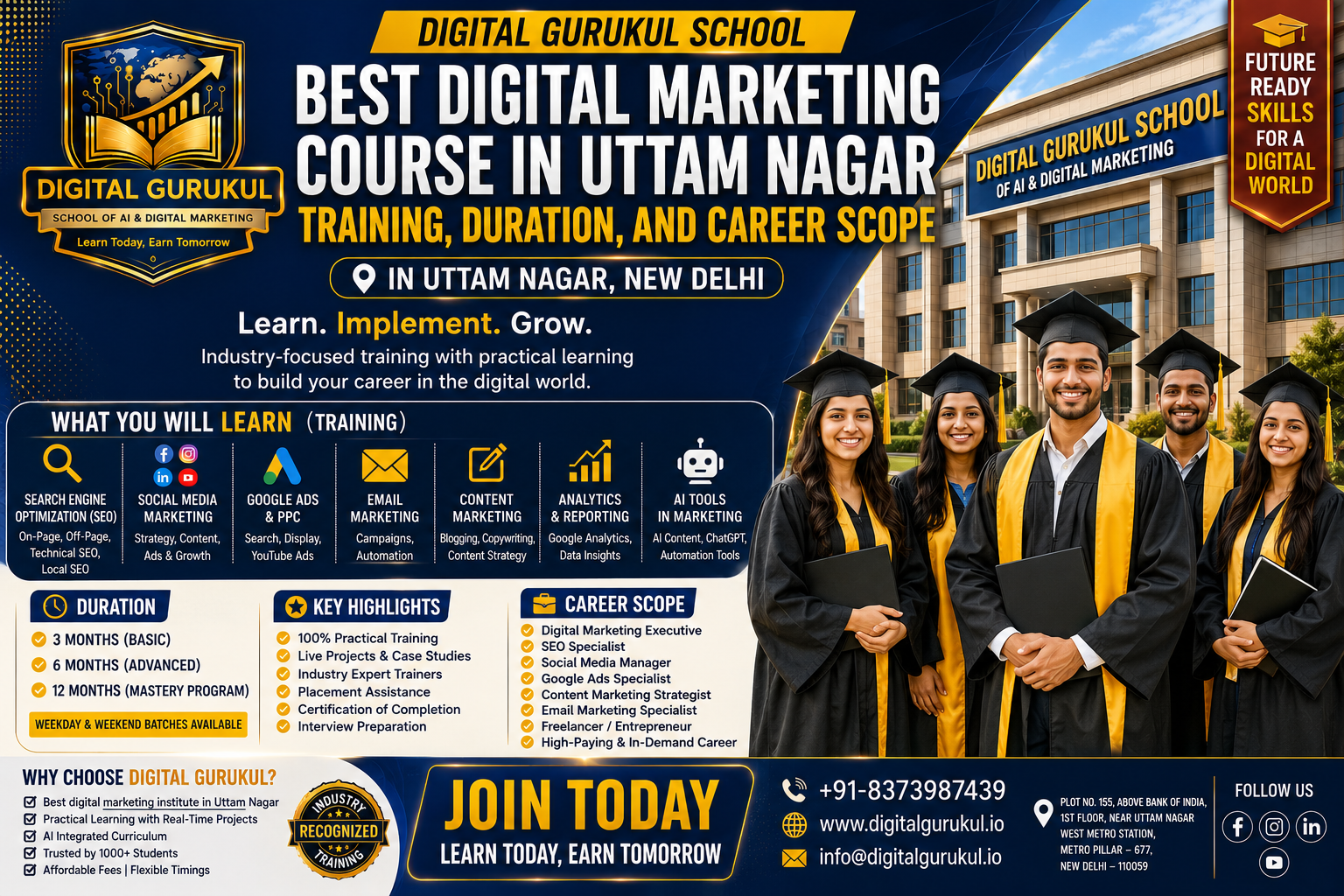
We are a leading AI Powered Digital Marketing & Data Science Institute in Uttam Nagar, Delhi. We provide 100% practical training in SEO, Google Ads, Social Media Marketing, Artificial Intelligence, and Automation tools to help students build high-income careers, freelancing skills, and business growth.