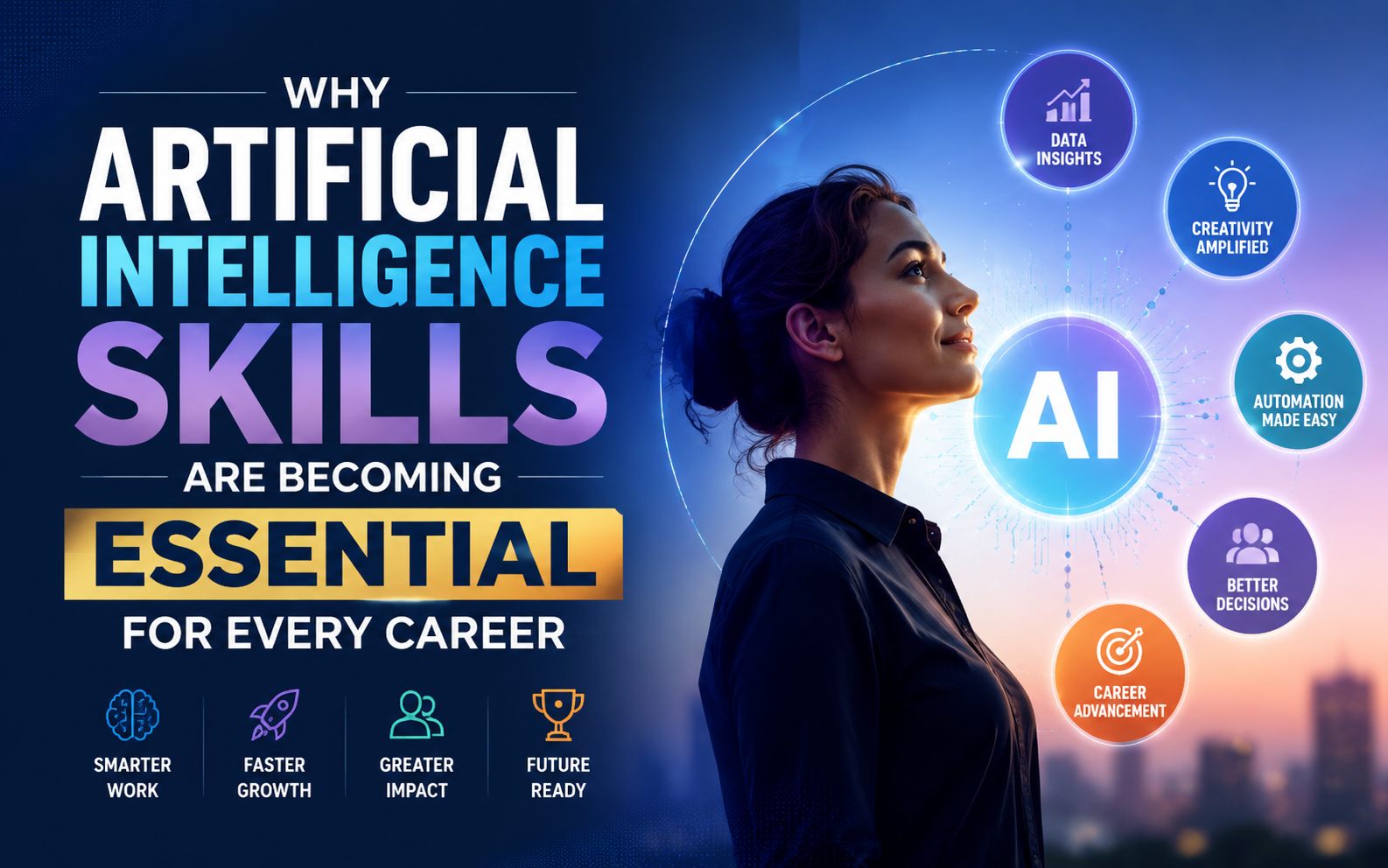
Why Artificial Intelligence Skills Are Becoming Essential for Every Career
.
.
A decade ago, "AI skills" meant something only data scientists and engineers needed to worry about. That assumption no longer holds. From marketing managers to HR professionals to supply chain analysts, employers across every sector now expect some level of AI fluency — and the job market data backs this up in a big way.
Based on PwC's 2026 Global AI Jobs Barometer, positions requiring specific AI skills are expanding approximately eight times faster than the broader job market. Indeed's 2026 Hiring Lab data shows AI-related postings are 134% above pre-pandemic levels, and Lightcast reports that 51% of these roles exist outside of traditional IT departments. As a result, enrolling in an Artificial Intelligence Course is now crucial for maintaining career competitiveness.
In this article, we'll break down why AI skills matter, which industries are being reshaped fastest, and how the right AI Certification can position you for the roles employers are actively trying to fill.
The demand for AI skills is growing rapidly across various industries, including marketing, HR, and data analysis, transitioning AI proficiency from a specialized advantage into an essential workforce requirement. Research shows that roles requiring AI skills increased sevenfold from 2023 to 2025, and AI Engineer has become the fastest-growing job title in the United States with a 143% increase in postings. This trend is also evident in entry-level hiring, where over one-third of all positions now require AI skills.
Learning Artificial Intelligence offers significant financial benefits. Research by PwC indicates that individuals with AI expertise can earn up to 56% more than those without these skills in the same role. This wage premium applies across all industries and is true for both early-career workers and experienced professionals.
According to the Bipartisan Policy Center, the number of jobs requiring Artificial Intelligence skills has increased by 144% in the past year. Similarly, an Upwork report indicates a 109% global increase in freelance positions demanding AI expertise. Employers are willing to financially reward individuals who can effectively utilize AI, whether through prompt engineering, machine learning basics, or applying AI tools to enhance productivity.
An Artificial Intelligence certificate demonstrates to hiring managers that you possess verified, practical skills rather than superficial knowledge gained from basic tools like ChatGPT. This credential helps you stand out in a competitive job market where many claim proficiency without true expertise.
If you're planning your learning path, it helps to know exactly what's driving demand. Based on current hiring data, employers are prioritizing a mix of technical and applied skills:
Python mentions in AI job postings have risen from roughly 53,000 (2013–2015) to about 259,000 in 2025, making it the dominant language across data science and machine learning roles.
Including model evaluation, feature engineering, neural networks, and frameworks like TensorFlow and PyTorch, which are now considered near-essential for technical AI roles.
Widely considered the most democratized AI skill, since it doesn't require a coding background but dramatically boosts productivity across departments.
Increasingly important as companies move from experimenting with AI to deploying it reliably in production.
As organizations increasingly adopt Artificial Intelligence, they require professionals who understand data privacy, algorithmic transparency, and regulatory compliance, as well as how AI impacts these areas.
PwC's research indicates that entry-level jobs impacted by AI now require senior-level skills like leadership, strategic thinking, judgment, and creativity. This is because AI has taken over the routine tasks that junior employees traditionally used for on-the-job learning.
A skill set of its own, combining AI tools for SEO, content generation, campaign optimization, personalization, and performance analytics. As marketing teams fold AI directly into daily workflows, employers are actively seeking candidates who can run this hybrid skill set rather than treating AI as a separate add-on. A dedicated AI Powered Digital Marketing course is one of the fastest ways for marketers to build this exact combination of skills and stand out in job applications.
A well-structured AI Course typically covers this full spectrum — pairing hands-on technical training with the applied judgment employers say is increasingly hard to find.
Not every person who works in a job needs to learn how to make machines learn. That is good to know. There are different kinds of jobs that people can do if they want to work with artificial intelligence. These jobs can be very technical, like people who study intelligence and people who make sure the artificial intelligence systems work properly. There are also jobs that mix technology with things like people who manage artificial intelligence products people who come up with marketing plans that use artificial intelligence and people who make sure artificial intelligence is used in a responsible way. If you get a certificate in something like Amazon Web Services machine learning or Google machine learning you can get paid more money. People who have these certificates can get paid twenty to twenty five percent more, than people who do not have them even if they are doing the job. Artificial intelligence jobs are very different. People can choose what they want to do.
When evaluating an AI Career path and choosing where to invest your learning time, consider:
A marketer benefits more from a course focused on generative AI tools and applied prompt engineering than one built around neural network architecture.
Look for programs that combine theory (machine learning concepts, statistics) with hands-on projects using real datasets and tools.
An AI Certification from an established provider or platform carries more weight with recruiters than an informal course completion badge.
The strongest programs offer mentorship, portfolio-building guidance, and connections to hiring partners — not just video lectures.
Given that AI is projected to touch an estimated 170 million new roles globally by 2030 according to the World Economic Forum, the earlier you start building relevant skills, the more career options remain open to you.
Few areas show how much work is changing to use AI clearly as digital marketing. In the past people who do marketing were judged on how they could write ads make campaigns and understand data on their own. Now AI tools are used in every part of their work. And the facts show that marketing is one of the areas that is adapting to AI the fastest.
15% of job ads for marketing now mention AI, based on data, from Indeed for 2026. Marketing experts and managers are now expected to use AI that can create content as a main part of their job not just as a quick fix sometimes.
Here is where this change is most noticeable:
AI tools are streamlining traditional SEO tasks such as keyword research, content brief creation, topic grouping, and page optimization, reducing the time required from hours to minutes. While strategic planning remains essential, the role of the marketer has shifted to auditing, refining, and ensuring that AI-generated content aligns with search intent and matches the brand's unique voice.
AI-powered bidding platforms optimize and test ad campaigns in real time, allowing marketers to focus on creative strategy and performance analysis instead of manual A/B testing.
AI helps make content and product suggestions that're just right for each user. This was a challenge, for all but the biggest online shopping companies. Now even sized marketing teams can do it.
Marketing professionals are now expected to interpret AI-generated insights, such as customer behavior models and churn forecasts, to analyze campaign performance rather than building spreadsheets from scratch.
The integration of Artificial Intelligence is reshaping compensation and professional development in digital marketing. Marketing managers who can direct and validate AI outputs are securing higher salaries than their traditional counterparts, a trend mirrored across other AI-enabled roles.
Consequently, completing practical training, such as an Artificial Intelligence Course, has become essential. Rather than learning foundational machine learning from scratch, marketing professionals benefit most from applied instruction covering prompt engineering, SEO tools, content generation platforms, and analytics. Additionally, obtaining an Artificial Intelligence Certification validates practical expertise to employers and clients.
Ultimately, AI is no longer optional; it has become the standard mechanism for planning, executing, and measuring digital marketing campaigns.
Still weighing whether now is the right time to invest in this? Here are the questions we hear most from professionals exploring an Artificial Intelligence Course — answered directly.
1) Do I need a coding background to start an AI Course?
A programming background is not required to start a career in artificial intelligence. Beginners, including those in fields like marketing, human resources, or operations, can enter the field by utilizing existing AI tools and prompt engineering. They can start with foundational concepts and later acquire technical skills like Python or SQL if their specific career path requires it.
2) How long does it take to become job-ready?
AI certification programs typically vary in duration from a few weeks to several months depending on their depth. Rather than attempting to master every AI skill, it is recommended to start by learning two or three job-relevant skills, building a showable project, and gradually expanding your expertise from there.
3) Will an AI certification actually help me get hired, or is it just a resume line?
Employers seek verified skills rather than unsubstantiated claims. While certifications do not replace actual experience, they help get resumes noticed by human reviewers instead of automated systems. Furthermore, certifications provide candidates with the precise vocabulary to discuss their skills and qualifications during interviews.
4) I'm not in tech. Are AI Jobs really relevant to my industry?
More than half of AI-related jobs are now in non-tech fields like marketing, human resources, finance, and operations. Even if your industry does not require AI skills yet, data indicates it is only a matter of when, not if, they will become essential.
5) What's the single best first step?
To effectively build AI skills for your career, select a single, impactful skill that addresses an immediate problem in your current role. Enroll in a brief, reputable AI course to learn it, and then apply that skill to a workplace task within the month. Successfully leveraging this skill to solve a problem will provide tangible proof of your impact, which you can showcase on your resume and highlight during your performance review.
Have a question we didn't cover? Drop it in the comments — we read and respond to every one, and your question might shape our next deep-dive on AI Jobs and career paths.
The change to work that uses Artificial Intelligence is not something that will happen later. It is already changing the way companies hire people and pay them and the way people move up in their careers in 2026.
If you work in marketing, finance, human resources, operations or software development the facts are clear: people with Artificial Intelligence skills that can be verified are getting jobs faster earning money and doing a job of keeping their careers safe than people, without Artificial Intelligence skills.
Getting an Artificial Intelligence Course and a respected Artificial Intelligence Certification is one of the things you can do now to stay important in a job market that is changing very fast.
The time to learn Artificial Intelligence skills and use them to stand out is getting shorter. Soon companies will just expect everyone to have Artificial Intelligence skills.


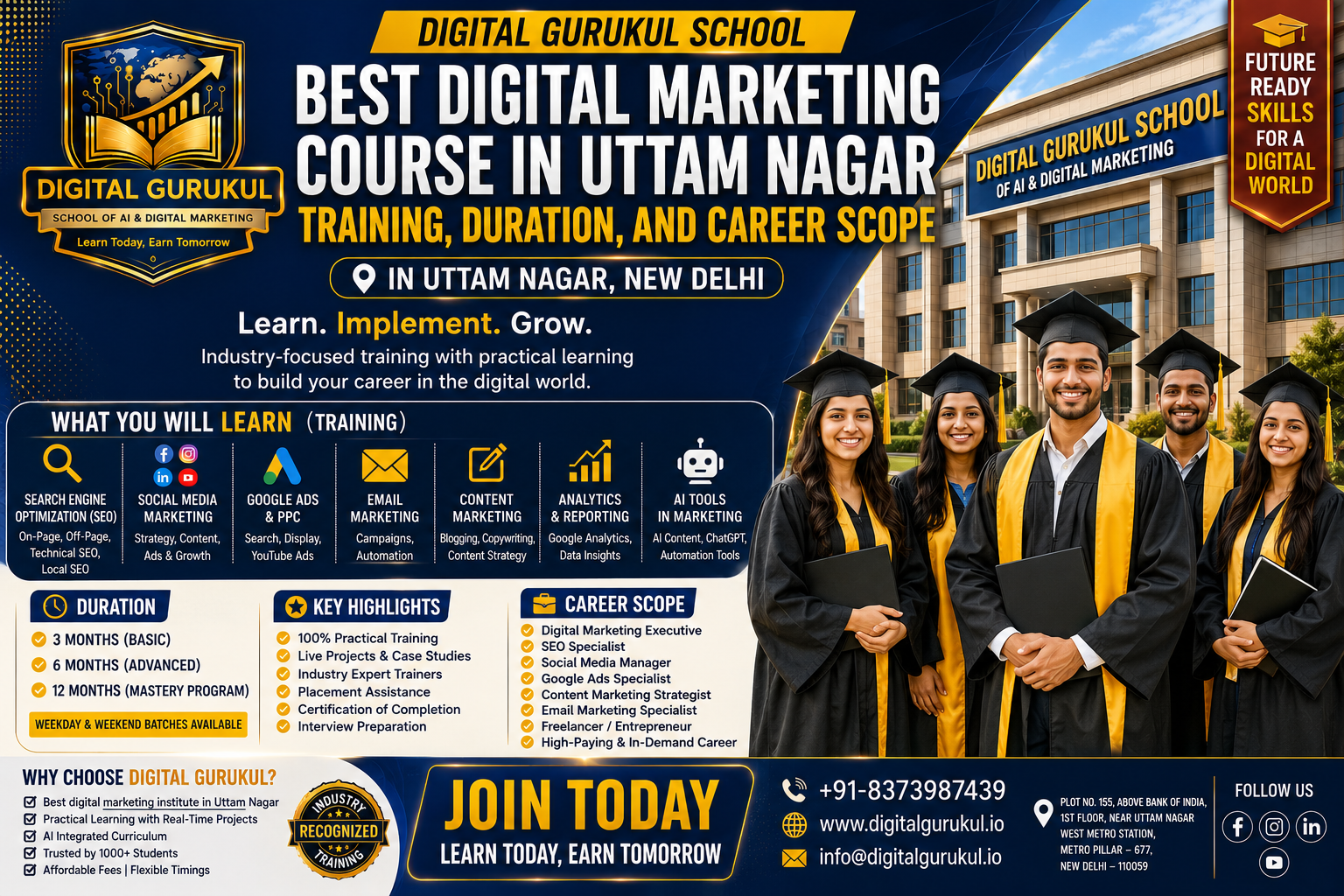
We are a leading AI Powered Digital Marketing & Data Science Institute in Uttam Nagar, Delhi. We provide 100% practical training in SEO, Google Ads, Social Media Marketing, Artificial Intelligence, and Automation tools to help students build high-income careers, freelancing skills, and business growth.